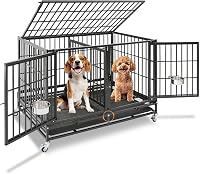
Is a 30x20x25 Dog Crate Large?
No, a 30x20x25 dog crate is not large. It's a medium wire crate for dogs up to about 40 lb, and most dogs over that weight need a 36-inch crate or bigger.
On this page (10 sections)
- What does a 30x20x25 dog crate measure?
- Is a 30x20x25 dog crate large enough for most dogs?
- How do you measure a dog for a 30-inch crate?
- When should you size up from a 30-inch crate?
- Is a 30x20x25 crate big enough for crate training?
- Which 30-inch crates are worth considering?
- Does crate size affect safety and training?
- How does a 30-inch crate compare to larger sizes?
- What are the alternatives if 30 inches is too small?
- So, is a 30x20x25 dog crate large?
No, a 30x20x25 dog crate is not large. It's a medium wire crate for dogs up to about 40 lb, and most dogs over that weight need a 36-inch crate or bigger.
The "30x20x25" label is the outside size in inches: about 30 long, 20 wide and 25 tall. Whether that counts as large depends on the dog you put in it, so the honest answer is that it's medium for most breeds.
What does a 30x20x25 dog crate measure?
A 30x20x25 crate is roughly 30 inches long, 20 inches wide and 25 inches tall. Those are outside dimensions, so the usable floor space inside is a little smaller after you allow for the frame and tray edges.
The MidWest 30-inch iCrate lists its size as 30.5 x 19.25 x 21.5 inches, so the numbers in a product name are close but not always exact. Always read the actual dimensions on the crate you plan to buy rather than trusting the shorthand in the title.
Height matters as much as length. A 25-inch crate gives a dog room to stand and turn, but a tall breed with long legs may only fit with its head close to the top.
Measure your dog standing up, not lying down.
The footprint is compact enough for a bedroom corner or the back of a small SUV. That's the main reason people choose this size: it fits a medium dog without taking over the room.
Is a 30x20x25 dog crate large enough for most dogs?
For most dogs, no. A 30-inch crate suits dogs in the 21 to 40 lb range, such as French Bulldogs, Welsh Terriers and Dachshunds, according to MidWest.
That's medium territory. Breeds at the top of that band, close to 40 lb, can fit but end up cramped as they grow.
MidWest itself suggests sizing up to a 36-inch model for dogs near 40 lb.
Large breeds like Labradors, German Shepherds and Golden Retrievers are well past this crate. So are many mixed breeds that look medium as puppies and end up over 50 lb.
Here's the rough picture:
- Under 20 lb: small crate territory, often 24 inches.
- 21 to 40 lb: 30-inch crate, the size in question.
- 41 to 70 lb: 36-inch crate or larger.
- Over 70 lb: 42-inch or 48-inch crate.
Those bands are guides, not rules. A long, low dog may need more length than a taller dog of the same weight, so the tape measure matters more than the breed label.
How do you measure a dog for a 30-inch crate?
Measure your dog's length and height, then add 2 to 4 inches of clearance. That extra room lets the dog stand, turn around and lie down stretched out.
For length, run the tape from the tip of the nose to the base of the tail while the dog stands. For height, go from the floor to the top of the head, or to the top of the ears if they stand up.
Then compare your numbers to the crate's interior, not its outside size. A dog that measures 27 inches long and 22 inches tall needs a crate with more than 27 inches of usable floor length and about 25 inches of headroom.
Do this once when the dog is full grown, and repeat monthly while it's still a puppy. A crate that fits at 4 months can be too small by 8 months, which is the most common sizing mistake.
When should you size up from a 30-inch crate?
Size up when your dog can't stand, turn or lie flat without touching the sides. Those three movements are the practical test for any crate.
Watch for a dog that has to duck its head, sleep curled in a tight ball, or press against the door to turn around. Those are signs the crate has become too small.
Weight is a second signal. A dog creeping past 40 lb usually needs a 36-inch crate, even if it still squeezes into the 30-inch one.
Puppies are the third case. If you know your puppy will grow into a large breed, buying a 30-inch crate now means buying again soon.
A 36-inch crate with a divider panel lets you keep one crate through the growth spurt.
Is a 30x20x25 crate big enough for crate training?
Yes, for a puppy expected to top out under about 40 lb. The size is small enough to discourage accidents and large enough for the puppy to move around.
The trick is a divider panel. It splits the crate into a smaller sleeping area while the puppy is tiny, then you move the panel back as the dog grows.
MidWest includes a divider with its 30-inch iCrate models for exactly this.
Crate training works best when the crate is a resting space, not a place for long stretches alone. A crate that's too big gives a puppy room to soil one corner and sleep in another, which slows house training.
For a large-breed puppy, skip this size. A 30-inch crate is a stopgap at best, and the money is better spent on the crate the dog will use as an adult.
Which 30-inch crates are worth considering?
The MidWest 30-inch single door iCrate is the strongest pick of the three. It has the most complete feature set for a medium dog and works for training and travel.
It measures 30.5 x 19.25 x 21.5 inches and carries a black e-coat finish that MidWest says resists rust. The Paw Block and locking latch tips add security, and the crate folds flat without tools for storage or travel.
Which 30-inch crate suits tighter spaces?
The MidWest 30-inch double door iCrate fits best in corners and against walls. Front and side doors give you two ways in and out.
The two doors mean you don't have to leave clearance in front of the crate. That helps in a small bedroom or beside a sofa.
It has the same divider, tray and folding frame as the single door model.
Which 30-inch crate is the simplest choice?
The Amazon Basics 30-inch crate is the no-frills option. It's a folding wire crate with one door, a divider and a removable plastic tray.
Amazon Basics sizes this crate for pets under 26 inches long and 17 inches tall, and names Beagles, Dachshunds, Shih Tzus and Chihuahuas as examples. That's a smaller dog than the MidWest 30-inch crates are built for.
A metal hook holds the tray in place, and the crate folds flat for transport. There's a top handle for carrying.
If your dog is close to 40 lb, the Amazon Basics crate is the tighter fit of the three. The MidWest models leave more room at the top of the weight band.
Does crate size affect safety and training?
Yes, and the fit matters more than the label. A crate that's too small restricts movement and can stress a dog; one that's too large gives a puppy room to make messes.
The crate should be a place the dog chooses to rest, not a punishment spot. Feed meals inside it and leave the door open during quiet time so the dog builds a positive association.
Check the latch and door every week. A dog that can nose the door open will practice escaping, and a loose latch on a folding crate is easy to overlook.
Never leave a dog in a crate all day. Crates are for short rests, overnight sleep and travel, and the dog needs exercise and bathroom breaks outside them.
How does a 30-inch crate compare to larger sizes?
A 30-inch crate is the middle step in a size ladder that runs from about 24 inches up to 48 inches. Each step up adds floor space and height for a bigger dog.
A 36-inch crate is the next size up and the usual choice for dogs in the 41 to 70 lb range. A 42-inch crate suits many large breeds, and a 48-inch crate is for the biggest dogs.
Stackable crates are a separate option for multi-dog homes or breeders. They save floor space by putting one crate above another, but the bottom crate still needs the same fit for its dog.
Folding crates suit travel and storage. A 30-inch crate folds flat, so it can slide into a closet or the back of a car when it isn't set up.
What are the alternatives if 30 inches is too small?
Move up to a 36-inch crate first. It's the smallest step that gives a dog near 40 lb real room to stretch, and most medium-to-large dogs fit it for life.
From there, the choice depends on the dog. A long-backed breed may do better in a 42-inch crate even at moderate weight, because length matters more than height for comfort.
If you're shopping for a large breed, start with our guide to the best extra large dog crate options. For homes with more than one dog, stackable dog crates save floor space.
Large breeds around 42 inches get a full run-down in our best 42 inch dog crate roundup. And if you need something that packs away between trips, the best collapsible dog crate for large dogs covers the folding options.
So, is a 30x20x25 dog crate large?
No, it's a medium crate. A 30x20x25 dog crate suits dogs up to about 40 lb and is too small for most large breeds.
The practical rule is simple. If your dog stands under about 22 inches tall and measures under about 26 inches nose to tail, a 30-inch crate can work.
Above that, move up to a 36-inch crate or larger.
Measure your dog before you buy, and remember that the size in the product name is the outside of the crate. The dog needs room inside, so give it a couple of inches of clearance on every side and it will have a crate it can actually rest in.
Frequently asked questions
Is a 30x20x25 dog crate big enough for a Labrador?
No. A Labrador is a large breed that needs far more floor space than a 30-inch crate offers.
Look at a 36-inch crate as the smallest option and measure your dog's length and height before you buy.
Can two small dogs share a 30x20x25 crate?
It's not a good idea. A 30-inch crate holds one dog in the 21 to 40 lb range comfortably.
Two dogs need separate crates so each one can stand, turn and lie down without crowding.
What size crate comes after a 30-inch crate?
A 36-inch crate is the next step up. From there the usual sizes are 42-inch and 48-inch crates.
Most medium dogs fit a 30-inch crate, while large breeds need 36 inches or more.
Is a 30-inch crate big enough for crate training a puppy?
Often yes, for a puppy expected to stay under about 40 lb as an adult. A divider panel lets you shrink the space while the puppy is small and open it up as the dog grows.