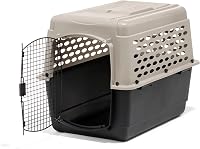
Best Dog Crates for Airplane Travel: How to Choose
The best dog crate for airplane travel is a rigid plastic kennel that meets IATA live-animal rules and your airline's cargo size limits. Match the interior to your dog's height and length first, then check ventilation, latch security and the tie-down holes.
On this page (8 sections)
- What makes a dog crate for airplane travel different?
- How do you size a dog crate for airplane travel?
- Which Petmate Sky Kennel fits your dog?
- Plastic or wire: which crate type flies?
- How do you check airline rules before you fly?
- What should you pack in the crate for the flight?
- How do you help a dog settle in a travel crate?
- Which size and setup should you buy?
The best dog crate for airplane travel is a rigid plastic kennel that meets IATA live-animal rules and your airline's cargo size limits. Match the interior to your dog's height and length first, then check ventilation, latch security and tie-down holes.
Air travel asks more of a crate than a car trip or a night at home. The kennel has to survive cargo handling, keep your dog ventilated, hold a water supply and lock shut through the whole journey.
That narrows the field to a specific kind of crate.
This guide explains what airlines look for, how to size the kennel, and which of the Petmate Sky Kennels fits each weight band. If you also drive with your dog, our best dog crates for cars guide covers road travel separately.
What makes a dog crate for airplane travel different?
A flying crate must meet the IATA live-animal standard and your airline's cargo rules. That means a rigid shell, secure door latches, ventilation on more than one side and tie-down holes so ground crews can strap the kennel in place.
A crate sold for home use or car rides doesn't automatically qualify. Airlines want a kennel that contains the dog, holds a water dish reachable from outside, and stays locked when it's lifted and moved.
Petmate says the Sky Kennel meets IATA requirements for live animal transport and meets most airline cargo specifications.
The differences show up in a few places:
- Shell and door: a molded plastic shell with an easy-squeeze latch door that has interlocks, so the door can't pop open in transit.
- Ventilation: 360-degree ventilation so air moves through the kennel from several directions, not just the door grille.
- Tie-down holes: strap points that let handlers fix the kennel to a pallet or cargo position.
- Travel kit: "LIVE ANIMAL" stickers, an ID sticker, a food and water cup and an absorbent pad.
Airline rules sit on top of the IATA standard. Each carrier can set its own size limits, route restrictions and temperature cutoffs, so the same kennel may fly one route and not another.
Confirm the flight before you buy anything.
Rule: buy a crate sold for air travel, not a home crate you hope will pass. The extra hardware is what gets your dog through the cargo hold safely.
How do you size a dog crate for airplane travel?
Measure your dog standing and lying down, then add clearance. The kennel must let the dog stand upright, turn around and lie stretched out, and the airline will check that fit at check-in.
Take three measurements with your dog standing on a flat floor:
- Height: from the floor to the top of the head or the tips of the ears, whichever is higher.
- Length: from the tip of the nose to the base of the tail.
- Width: across the widest part of the body, usually the shoulders or hips.
Add roughly 2 to 4 inches to the height and length so your dog can move without hitting the shell. Then compare those numbers with the kennel's interior dimensions, not its outside size.
A crate sold as 21 inches long can have a much smaller inside space once the walls and door take their share.
The Petmate Sky Kennel for Air Travel has interior dimensions of 18.75" L x 13.5" W x 14.5" H. The 28-inch model measures 24.25" L x 18.25" W x 19.5" H, and the 36-inch model measures 32.5" L x 22" W x 26" H.
Write those three sets down and match them against your measurements.
Weight is a rough guide only. The same dog can be short and heavy or tall and light, and a kennel chosen by weight alone can be too short.
Use the interior height and length as the deciding numbers, then confirm the weight band as a backup.
Rule: size by interior height and length first, weight second. A crate your dog can't stand up in will be refused even if the weight fits.
Which Petmate Sky Kennel fits your dog?
The Sky Kennel comes in three sizes that cover small, medium and large dogs. Pick the band that matches your dog's measured size and weight, then check the interior against your numbers before you order.
Petmate Sky Kennel for Air Travel: best for small dogs and cats
The 21-inch Sky Kennel is the pick for a Chihuahua-sized dog or a large cat. Petmate builds it for pets up to 15 lb and gives it interior space of 18.75" L x 13.5" W x 14.5" H.
A puppy or kitten that will fly small fits this band.
It's the best overall crate here because it covers the widest range of flyers in this group, from small dogs to cats. The full kit matters on a first flight: two "LIVE ANIMAL" stickers, an ID sticker, a food and water cup and an absorbent pad all come in the box.
The easy-squeeze latch door with interlocks and the folding top handle make it easier to carry and secure.
The shell is made in the USA from EcoTEC plastic with at least 90% pre-consumer recycled material. That's a real material choice, not just a label.
The interior is small, though, so a dog near the top of the 15 lb band needs a careful height check.
Pick the 21-inch Sky Kennel for a small dog or cat that measures under the interior height. A taller or longer dog moves up to the next size even if the weight still fits.
Petmate Sky Kennel 28-inch: best for small-to-medium dogs
The 28-inch Sky Kennel suits a dog in the 15 to 30 lb range, such as a Beagle or a Pomeranian. Petmate gives it interior dimensions of 24.25" L x 18.25" W x 19.5" H, which leaves a medium dog room to stand and turn.
It carries the same travel kit and the same IATA build as the small model: two "LIVE ANIMAL" stickers, an ID sticker, a food and water cup and an absorbent pad. The 360-degree ventilation and tie-down strap holes are there too, and the latch door has interlocks.
This size is the middle step for owners whose dog outgrew the 21-inch crate. The weight guidance runs from 15 to 30 lb in the title and 20 to 30 lb in the bullets.
Measure your dog rather than trusting the label, especially around 15 to 20 lb.
Pick the 28-inch Sky Kennel for a Beagle-sized dog that needs more length than the small crate allows. If your dog stands taller than 19.5 inches inside, go up to the 36-inch.
Petmate Sky Kennel 36-inch: best for large dogs
The 36-inch Sky Kennel is the large-dog option for pets from 50 to 70 lb, like an Australian Shepherd. Petmate gives it interior space of 32.5" L x 22" W x 26" H, so there's room to lie down and stretch during a long flight.
The travel kit and construction match the smaller models. You get the two "LIVE ANIMAL" stickers, the ID sticker, the food and water cup, the absorbent pad, the latch door with interlocks and the 360-degree ventilation.
The shell is the same EcoTEC plastic with at least 90% pre-consumer recycled material.
The big trade-off is weight and handling. A 36-inch kennel is a large object to lift into a vehicle and move through an airport, and it takes up more space in the cargo hold.
It also costs more than the smaller sizes. For a dog near the top of the 70 lb band, check the interior height carefully before you commit.
Pick the 36-inch Sky Kennel for an Australian Shepherd-sized dog that needs 26 inches of interior height. A dog over 70 lb needs a larger kennel than any size here.
Plastic or wire: which crate type flies?
Plastic wins for air travel. A rigid plastic kennel contains the dog, holds a water cup and pad, and has tie-down holes for the cargo hold.
A wire crate is open, has no pad floor and isn't built for airline handling.
Plastic travel crates also keep drafts and cargo-hold noise down, and the enclosed shell gives your dog a calmer space during loading. The Sky Kennel's molded shell, latch door and ventilation slots are all part of that design.
Our best plastic dog crates guide covers the plastic options in more depth.
Wire crates have their place for home and car use. They're easy to fold, you can see your dog from any angle, and they ventilate well.
Those same openings work against you in a cargo hold, where a dog needs a contained space and a pad that stays put.
The third option is a soft carrier. Soft carriers are for cabin travel with small pets, not cargo.
They don't meet the IATA standard for a full-size dog crate. Our dog crate vs carrier comparison explains when each one makes sense.
Rule: fly a plastic travel crate, keep the wire crate for home. The type of crate matters as much as the size.
How do you check airline rules before you fly?
Check your airline's cargo rules before you buy the crate. IATA sets the base standard, but each airline adds its own size limits, weight caps, route restrictions and temperature rules for live animal transport.
Ask the airline these questions when you book:
- Does this aircraft and route accept pets in the cargo hold?
- What are the maximum kennel dimensions and weight for this flight?
- Is there a temperature limit at either airport on the travel day?
- What health certificate and vaccination records does the airline need?
- When and where do I check the pet in on the day?
Petmate says the Sky Kennel meets IATA requirements for live animal transport and meets most airline cargo specifications. "Most" is the key word.
A regional carrier or a smaller aircraft can still say no, and some airlines stop carrying pets in cargo on certain routes.
The travel kit helps here. The "LIVE ANIMAL" stickers and the ID sticker go on the outside of the kennel, and the food and water cup lets staff top up water without opening the door.
Keep your contact details and destination on the ID sticker so the kennel is easy to trace.
Book early and confirm in writing if you can. A crate that meets the rules can still be turned away at check-in if the route or the weather doesn't fit the airline's limits.
Rule: confirm the route and the size cap with the airline before the crate arrives. The rules decide the crate, not the other way round.
What should you pack in the crate for the flight?
Pack light. A flight crate needs an absorbent pad, a water supply and ID, and not much else.
Anything loose can shift during handling or become a hazard if your dog chews it.
The Sky Kennel kit covers the basics: an absorbent pad for the floor, a food and water cup, and the "LIVE ANIMAL" and ID stickers. Add a familiar blanket or a worn T-shirt that smells of home if the airline allows soft bedding, and make sure it can't bunch up under your dog.
Skip toys with small parts and anything with a long strap. A collar is fine, but a loose leash inside the kennel can catch on the door or the ventilation slots.
Attach the leash outside and remove it before the kennel goes into the hold.
Label the kennel clearly. Put your name, phone number and destination on the ID sticker, and add a second label on the top or side so it's visible from more than one angle.
A live-animal sticker on each long side helps handlers see the kennel is occupied.
Feed and water your dog on the airline's schedule, not yours. Most carriers ask for a light meal a few hours before the flight and water available in the kennel.
The cup in the kit lets staff reach in without opening the latch door.
Rule: keep the inside simple and the outside labeled. A pad, water and ID are the core kit.
How do you help a dog settle in a travel crate?
Get your dog used to the kennel weeks before the flight. A crate that only appears on travel day feels strange, and a calm dog is easier to handle at check-in and in the cargo hold.
Start by leaving the kennel open at home with the door off or tied back. Put a familiar blanket inside and feed your dog near it so the crate becomes a normal part of the room.
Short sessions with the door closed and treats after each one build the habit.
Work up to longer stretches and to the latch door closing. Add the absorbent pad and the water cup so your dog meets the full setup before the flight.
If your dog is anxious in enclosed spaces, talk to your vet about the trip well in advance rather than on the morning of the flight.
On travel day, keep the routine calm. Exercise your dog before the airport, feed on the airline's schedule and stay relaxed at check-in.
Hand the kennel over with the ID sticker and the live-animal stickers in place.
A crate with wheels can help if you'll be moving a large kennel through a busy airport. Our best dog crates with wheels guide covers the rolling options for bigger dogs.
Rule: train in the crate for weeks, not minutes. Familiarity does more for a calm flight than any last-minute trick.
Which size and setup should you buy?
Buy the smallest Sky Kennel that gives your dog room to stand, turn and lie down. Size by the interior measurements, not the weight band alone, and confirm the route with your airline before you order.
For most small dogs and cats, the 21-inch Sky Kennel for Air Travel is the best dog crate for airplane travel. It covers pets up to 15 lb, comes with the full travel kit and has the interior space a small flyer needs.
Move up to the 28-inch model for a Beagle-sized dog in the 15 to 30 lb range, and to the 36-inch model for a large dog from 50 to 70 lb.
The final checks are the same for every size: measure your dog standing and lying down, compare those numbers with the interior dimensions, and confirm the airline's cargo size and route rules. A crate that meets IATA and your airline's limits is the one that gets your dog through the journey safely.
If your dog also travels by car, pair this guide with our best dog crates for cars roundup so the same dog has a safe setup on the road as well as in the air. And when you're deciding between a full crate and a soft bag for cabin travel, the dog crate vs carrier comparison settles which one to pack.
Rule: buy the smallest size your dog measures into, and confirm the flight first. That's the whole decision in one line.
Frequently asked questions
Can any dog crate go in an airplane cabin?
No. A full-size dog crate for airplane travel goes in the cargo hold, not the cabin.
Cabin travel is limited to small pets in a soft or hard carrier that fits under the seat, so check your airline's cabin size limits before you plan around a crate.
What does IATA compliance actually mean for a travel crate?
It means the kennel is built to the IATA live-animal transport standard for ventilation, door security and tie-down points. Airlines can still add their own size and route rules on top, so confirm the specific flight before you buy.
How much room should my dog have inside the crate?
Your dog needs to stand upright without ducking, turn around without touching the walls, and lie down fully stretched out. Measure height at the head or ears and length from nose to tail base, then add a little clearance for movement during the flight.
Do I need to attach food and water bowls for a flight?
Most airlines ask for a food and water dish that can be reached from outside the kennel without opening the door. The Petmate Sky Kennels include a food and water cup and an absorbent pad, which covers the basic in-flight needs.
Is a plastic kennel or a wire crate better for flying?
Plastic is the usual choice for air travel because it encloses the dog, holds a pad and water cup, and has tie-down holes for the cargo hold. Wire crates are more open and are not built for airline cargo handling, so save them for home and road trips.
What paperwork should travel with the crate?
Attach a live-animal sticker and an ID tag with your name, phone number and destination, and keep health and vaccination records with you. Airlines handle the rest of the manifest, so ask them what they need at check-in.