Dog Crate vs Carrier: Which Is Better? (October 2026)
Choose a dog crate for a home setup and a carrier for trips with a small pet. For car travel or flights, pick an enclosure that fits your dog and the trip's rules.
On this page (8 sections)
- Dog crate vs carrier: what is the difference?
- Which option works best at home?
- Which one is better for car travel?
- Is a crate or carrier better for flying?
- How do you choose the right size?
- What features matter for comfort and handling?
- How should you set up and care for a crate or carrier?
- Which dog crate or carrier should you choose?
Choose a dog crate for home use and a carrier for trips with a small pet. For car travel or flights, pick an enclosure that fits your dog and the trip's rules.
Some hard-sided travel kennels are called crates or carriers. The useful difference is how you plan to use the enclosure: a wire crate suits a home space, while a carrier is sized and built to move a pet.
This guide compares home use, car travel, air travel, fit and handling.
For a broader look at materials and trade-offs, see our guide to wire vs plastic dog crates.


Dog crate vs carrier: what is the difference?
A crate is an enclosure for a dog, while a carrier is made to transport a pet. Some travel crates can fill both roles if their size and features work for your home and trip.
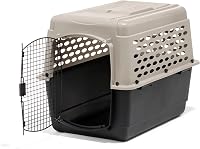
The MidWest 30-inch single door iCrate is a metal wire crate with a divider panel, tray and rubber feet. The Petmate Sky Kennel 28-inch is a hard-sided plastic kennel with ventilation and travel accessories.
The Amazon Basics hard-sided 2-door pet carrier has a smaller interior and front and top entry. It is intended for a cat or a medium-size dog in the 12 to 20 lb reference range, but measurements matter more than weight alone.
The name matters less than the fit and features. Compare the usable interior, how you'll carry or secure the enclosure, and any rules for your destination.
Which option works best at home?
A wire crate is the more flexible choice for a regular home setup. Its open sides, divider and tray suit everyday placement and crate training.
The MidWest iCrate measures 30.5 x 19.25 x 21.5 in and has one door. A divider panel lets you adjust the usable space as a puppy grows, and the leak-proof tray can be removed for cleanup.
Open wire sides let a dog see the room, which may suit a pet that settles better near household activity. They offer less visual separation than solid plastic walls, so skip this style if your priority is a more enclosed space.
The Sky Kennel and Amazon Basics carrier have hard sides that create a more enclosed area. Their interiors may suit a pet that fits comfortably, but neither is a substitute for a larger home crate when your dog needs more room.
Set the crate on a level spot where the door can open fully and the tray can slide out. Keep the area around the enclosure clear, and choose a location that lets you supervise your dog without blocking household movement.
If you're considering a wire model for daily use, our wire dog crate guide covers size, doors and tray features. You can also measure your dog for a crate before settling on a size.
Which one is better for car travel?
Choose a travel crate or carrier that fits your pet and can be secured in your vehicle. An enclosure that fits in the cargo area still needs a safe placement plan.
The Sky Kennel has a folding top handle, a front door and tie-down strap holes. The Amazon Basics carrier has a top carry handle and front and top doors, but its compact dimensions make it a better match for smaller pets.
The iCrate folds flat without tools, which helps with storage or transport when it is empty. Its wire construction and larger size can make it less convenient to carry as a pet carrier, especially with a dog inside.
Before a drive, check whether the enclosure can be anchored or restrained in your vehicle. Our guide to securing a dog crate in a car explains what to consider for a stable setup.
What should you check before a road trip?
Check the vehicle space, door route and enclosure fit before leaving. Measure the space where the crate will sit, including room for ventilation and access.
Check that latches close fully and that the enclosure stays upright in its planned position. Follow the vehicle and enclosure instructions, and plan stops for longer trips.
Avoid choosing a carrier only because it fits on the seat or in the cargo area. Your pet still needs enough room inside, and you need a way to keep the enclosure stable.
Is a crate or carrier better for flying?
Use an enclosure that meets the airline's requirements for your specific trip. General travel claims do not replace checking current airline rules.
The Petmate Sky Kennel meets IATA requirements for live animal transport and most airline cargo specifications. It includes two “LIVE ANIMAL” stickers, ID stickers, a food and water cup, and an absorbent pad.
Those details make it the clearest fit of these three for planning air cargo travel with a pet that fits its interior. The interior measures 24.25 x 18.25 x 19.5 in, so compare your pet's body measurements before considering it.
The Amazon Basics carrier is described for small pets, and its product facts do not tell you whether it will be accepted for air travel. Confirm with the airline before considering it for a cabin or cargo trip.
The iCrate is a home-style wire crate. Its fold-flat design helps with storage, but it is not described as an airline travel kennel.
Do not assume that the same carrier will meet every airline's rules. Check the trip's exact requirements before booking, then make sure your pet can use the enclosure comfortably for the planned journey.
How do you choose the right size?
Measure your dog and compare those measurements with the usable interior, then confirm your pet can stand, turn and lie down. Weight ranges help narrow options, but they cannot confirm fit by themselves.
The Sky Kennel is described for pets weighing 20 to 30 lb and has published interior dimensions. The Amazon Basics carrier gives a 12 to 20 lb reference range and says to choose by the pet's height and length.
The iCrate is described for dogs weighing 21 to 40 lb, with a suggestion to consider the 36-inch model for dogs near 40 lb. Use your dog's measurements and the crate's dimensions to decide whether this 30-inch model gives enough room.
Measure your pet while standing and note the length from nose to the base of the tail. Compare both length and height with the enclosure's usable interior, not just its outside size.
Our dog crate buyer's guide explains how to compare measurements and crate types. If your dog is near the upper end of a size range, check the next size rather than assuming weight settles the fit.
Dog crate vs carrier for a puppy
A puppy may outgrow a carrier quickly, so plan around the dog's expected adult size and how long you'll use the enclosure. The iCrate divider lets you adjust the usable space as a puppy grows.
A small carrier makes sense for trips only while the puppy fits it. For a home training space, a crate with an adjustable divider can be more practical than replacing a small carrier as the dog grows.
For crate training basics and a puppy-friendly setup, read how to set up a dog crate. Introduce the enclosure gradually and keep the space appropriate for the puppy's current size.
What features matter for comfort and handling?
Match the doors, ventilation and carrying features to how you'll use the enclosure. Extra entry points can help with access, while a handle matters when you need to lift a carrier.
The Amazon Basics carrier has front and top doors, spring-loaded latches and ventilation on the sides, top and back. Its top door swings open to either side, giving another way to place a small pet inside.
The Sky Kennel has 360-degree ventilation and an easy-squeeze latch door with interlocks. It also has a folding top handle and integrated side handles for transport.
The iCrate has a single door, rounded corner clips, a slide-bolt latch with Paw Block, rubber feet and a carrying handle. Those features suit a stationary home crate, while the removable tray helps with cleanup.
No feature makes an enclosure comfortable if it is too small. Check interior dimensions and door access first, then consider handles and accessories.
How should you set up and care for a crate or carrier?
Set up the enclosure on a stable surface, check every latch and keep ventilation open. A few minutes of preparation helps you spot fit or access problems before daily use or travel.
For a wire crate, unfold it on a level floor, secure the panels and confirm the door swings freely. Check that the tray is seated and the rubber feet contact the floor.
For a hard-sided kennel or carrier, make sure the top and bottom are securely joined and the door latches close fully. Keep vents unobstructed, especially if you add a pad or other soft item.
Remove bedding or accessories before cleaning the tray or interior. Let cleaned parts dry before putting them back, and inspect seams, hinges and latches regularly for loose or damaged parts.
What mistakes should you avoid?
Do not choose by weight alone, block ventilation or assume a carrier is approved for every trip. Those shortcuts can lead to a poor fit or a setup that does not suit the journey.
Avoid buying a carrier that only matches your pet's current weight range without checking its interior length and height. Don't force a dog into a compact model because it fits the car.
Do not place the enclosure where the door cannot open fully or where you cannot reach the latch. For travel, check both how the enclosure fits the vehicle and how your pet fits inside it.
Which dog crate or carrier should you choose?
Choose the MidWest iCrate for home crate use, the Petmate Sky Kennel for travel planning, and the Amazon Basics carrier for a small pet that fits its compact interior. Let your dog's measurements and trip requirements make the final choice.
The iCrate is the strongest home option here because its divider and leak-proof tray support a regular crate setup. The Sky Kennel is the travel-focused pick, with ventilation and included travel accessories.
The Amazon Basics carrier suits smaller pets that benefit from top and front access. Its 22.8 x 15 x 13 in dimensions make careful measurement especially important.
For more travel choices, compare our best plastic dog crates and best dog crates for cars. In the dog crate vs carrier decision, choose by use first, then confirm fit, access and travel requirements.
Frequently asked questions
Is a dog crate the same as a carrier?
A dog crate is a broader enclosure for home use or travel, while a carrier is designed to transport a pet. Some hard-sided travel crates serve both roles, but size, ventilation, handles and travel rules determine whether a particular model fits your trip.
Can I use a dog crate as a carrier in the car?
You can use a travel crate in a car if it fits the dog and can be secured in your vehicle. A standard home crate may be bulky or lack features suited to transport, so check the exact crate and vehicle guidance before driving.
Which is better for air travel, a crate or a carrier?
The airline's rules and your dog's size decide which travel enclosure works. The Petmate Sky Kennel meets IATA requirements for live animal transport and most airline cargo specifications, but airlines can set their own requirements, so confirm with your carrier before booking.
How do I know if my dog fits a carrier?
Measure your dog's length and standing height, then compare those measurements with the carrier's usable interior. Weight is only a reference for some models.
Your pet needs enough room to stand, turn and lie down for the planned trip.
Can a carrier replace a crate at home?
A carrier can work as a small, enclosed resting space if its dimensions suit your dog and it has the access and ventilation you need. A larger crate may be easier for everyday use, especially when you want a divider, tray or more room.