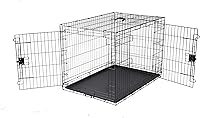
36 Inch vs 42 Inch Dog Crates: Which Is Better? (October 2026)
Choose a 36-inch crate if your dog fits its dimensions; choose a 42-inch crate if it needs more room. The 36 inch dog crate vs 42 choice depends on your dog's measurements, not weight alone.
On this page (10 sections)
- 36 inch dog crate vs 42: which size should you choose?
- How do you measure your dog for the right crate?
- When is a 36-inch crate the better fit?
- When should you move up to a 42-inch crate?
- How much room does a 42-inch crate need at home?
- Which size suits a Labrador or Golden Retriever?
- How do you set up and care for either crate?
- What common sizing mistakes should you avoid?
- Which 42-inch crate should you choose?
- How should you make the final 36-inch versus 42-inch choice?
Choose a 36-inch crate if your dog fits its dimensions, and a 42-inch crate if it needs more room. This 36 inch dog crate vs 42 comparison covers fit, layout and setup so you can choose a size that works for your dog and your home.
The MidWest 36-inch iCrate is suggested for dogs weighing 41 to 70 lb. The two 42-inch options are suggested for dogs weighing 71 to 90 lb, but weight is only a starting point.
Your dog should be able to stand naturally, turn around and lie down in a comfortable position. Measure your dog and the space where the crate will go before you decide.


36 inch dog crate vs 42: which size should you choose?
Choose the 36-inch crate when your dog's measurements fit it; choose 42 inches when your dog needs more length, width or height. The 42-inch options also take up more floor space, so the right fit depends on both your dog and your room.
The 36-inch iCrate measures 36.5 x 23.25 x 24.75 in. The MidWest 42-inch single-door iCrate measures 42.5 x 28.5 x 30.5 in, while the New World double-door crate measures 42.88 x 28.75 x 30.38 in.
These are wire crates with a leak-proof tray, rubber feet and carry handle. The two MidWest iCrates include divider panels; the New World divider is sold separately.
A bigger crate is not automatically the better choice. If your dog fits the 36-inch size comfortably, the extra floor area of a 42-inch crate may not be useful.
If your dog has little room to stand, turn or settle in the 36-inch model, size up.
How do you measure your dog for the right crate?
Measure your dog standing naturally, then compare its height and length with the crate's interior space. Weight ranges can help narrow the choices, but dogs with the same weight can have different builds.
Measure from your dog's nose to the base of its tail for length. For height, measure from the floor to the top of its head or ears, whichever is higher when it stands naturally.
Your dog needs room to stand without crouching and turn around. It also needs to lie down without being cramped.
Use the measurements as a fit check, rather than relying on breed names or weight alone. Our guide to measuring a dog for a crate explains how to take each measurement.
For a puppy, consider the adult size it is expected to reach. A divider can make a larger crate usable as the dog grows, but the divider needs to be included or available for the model you choose.
See our puppy crate size guide for help choosing a size for a growing dog.
What if your dog is between crate sizes?
Lean toward 42 inches when the 36-inch crate leaves too little room for your dog's natural posture. MidWest suggests considering its 42-inch model for a dog near the 36-inch iCrate's upper suggested weight of 70 lb.
A dog close to that weight may still fit the 36-inch crate if its measurements allow comfortable movement. A taller or longer dog may need more space even below that weight.
Don't buy the smaller size just to save floor space if your dog cannot move comfortably inside it. And don't assume the larger size is necessary when your dog already fits the smaller frame.
For a puppy, use a divider to adjust the space as it grows.
When is a 36-inch crate the better fit?
The 36-inch crate suits a medium-large dog that fits its dimensions and needs a smaller footprint than a 42-inch model. Its included divider also makes it a practical choice if you want one crate to adjust as a puppy grows.
The MidWest 36-inch iCrate is suggested for dogs from 41 to 70 lb. It has a single door, divider panel, leak-proof tray and rubber feet.
Choose it when your dog can stand, turn and lie down comfortably inside, and the crate fits the intended spot. Its single door works best when you can point the entrance toward clear floor space.
Skip this size if your dog's measurements make the crate feel cramped or your dog is near the top of its suggested range and needs more space. MidWest specifically suggests considering the 42-inch model for dogs near 70 lb.
When should you move up to a 42-inch crate?
Choose a 42-inch crate when your dog needs more room than the 36-inch frame provides. Both 42-inch options are suggested for dogs weighing 71 to 90 lb, and each is suited to a different room layout.
The MidWest 42-inch single-door iCrate includes a divider panel. That makes it the straightforward choice if you need a divider for a growing dog and can place the single entrance where it remains easy to reach.
The New World 42-inch model has front and side doors, which can help when one entrance would be blocked by a wall or furniture. Its compatible divider panel is sold separately, so factor that into your choice if you need to adjust the space for a puppy.
Skip either 42-inch option if it crowds the room or your dog fits the 36-inch crate comfortably. For more large-crate choices, see our guide to 42-inch dog crates and extra-large dog crates.
How much room does a 42-inch crate need at home?
A 42-inch crate needs a larger floor footprint than the 36-inch model, plus open space in front of its door. Measure the floor area and access space before bringing the crate home.
The 36-inch model measures 36.5 x 23.25 in at the base, while the 42-inch single-door iCrate measures 42.5 x 28.5 in. The New World double-door crate is slightly wider than that single-door model.
Mark the footprint on the floor with tape and leave room to reach the latch, open the door and remove the tray for cleaning. Check that the crate won't block a hallway, cabinet or doorway you use often.
If a single door would face a wall or furniture, the New World's front and side doors may give you more placement options.
The two iCrates have one door each, so decide which way it will face before setting up the crate. Our guide to where to put a dog crate at home has more placement tips.
Which size suits a Labrador or Golden Retriever?
Use your individual dog's measurements to choose, because a breed name doesn't guarantee one crate size will fit every dog. A Labrador or Golden Retriever may need a 36-inch or 42-inch crate depending on its height, length and build.
The 36-inch iCrate names Bulldogs, Beagles and Whippets as examples of similar breeds, while the 42-inch models name Australian Shepherds, Boxers and Golden Retrievers. Those examples help orient your search, but your dog's posture and measurements should guide the decision.
A dog that weighs less than the suggested range can still need more room if it is tall or long. Likewise, a dog near a size boundary may fit the smaller option if it has enough space to move naturally.
Read our guidance on crate sizing for Labradors and crate sizing for Golden Retrievers, then measure your dog before choosing.
How do you set up and care for either crate?
Set the crate on a level floor, check that its panels and latches are secure, and leave clear access to the door. Both MidWest iCrates and the New World crate are designed for tool-free assembly and include a carry handle and leak-proof tray.
Follow the assembly instructions that come with your chosen crate, then check that each panel is in place and the door opens and latches without obstruction. Keep the entrance clear so your dog can enter and exit without squeezing past furniture.
Place the tray correctly before use. Remove it when you need to clean it.
Regularly clear bedding and debris from the floor and corners, and check the wire and latch areas for damage or anything that could snag your dog. Our dog crate cleaning guide covers a simple cleaning routine.
For puppy use, set the divider to allow enough room for the puppy to stand, turn and lie down. Recheck the fit as your dog grows, and remove or adjust the divider when it no longer suits the dog's size.
What common sizing mistakes should you avoid?
The most common mistake is choosing by the number on the crate or the dog's weight without checking actual fit. Compare your dog's measurements with the crate and check the space needed for setup.
- Don't assume every dog of a breed needs the same crate. Breed examples are a starting point, while individual height and body length determine fit.
- Don't buy the smaller option to save space if your dog can't move comfortably. A tight fit makes the crate a poor choice even if the weight range appears right.
- Don't choose the larger option without measuring your room. Include door swing, access to the latch and room to remove the tray.
- Don't overlook the divider. The MidWest iCrates include one, while the New World compatible divider is sold separately.
- Don't forget door direction. A single-door crate needs clear space at its entrance; front and side access can make placement easier in some rooms.
The complete dog crate guide can help if you're still weighing crate styles, sizes and setup choices.
Which 42-inch crate should you choose?
Choose the MidWest 42-inch single-door iCrate if an included divider is a priority; choose the New World double-door crate if you need front and side access. Both offer a larger frame for dogs that need more room than the 36-inch option.
The MidWest model is the simpler fit for a growing dog when you want the divider included. The New World model makes sense when the room layout benefits from two door locations, but you will need to buy its compatible divider separately if you need one.
Neither 42-inch model solves a fit problem if the crate will be too large for your room or still too small for your dog. Check the actual dimensions and floor plan first.
How should you make the final 36-inch versus 42-inch choice?
Pick 36 inches if your dog fits comfortably and the smaller footprint suits your room; pick 42 inches if your dog needs more space. The right 36 inch dog crate vs 42 decision starts with measurements, then comes down to divider and door needs.
Choose the MidWest 36-inch iCrate for a dog that fits its frame and a room where a single door works. Choose the MidWest 42-inch iCrate for more space with a divider included, or the New World 42-inch crate when front and side doors suit your layout.
If you are still unsure after measuring, use our complete dog crate guide to compare the other choices that affect fit and daily use.
Frequently asked questions
Is a 36-inch or 42-inch crate better for a Labrador?
Either size may fit, depending on your Labrador's adult build and measurements. The 36-inch iCrate is suggested for dogs from 41 to 70 lb, while the 42-inch models are suggested for dogs from 71 to 90 lb.
Measure your dog and check that it can stand, turn and lie down comfortably.
How do I know if my dog needs a 42-inch crate?
A 42-inch crate may suit a dog that is too tall or long for a 36-inch crate, or one near the 36-inch model's suggested upper weight range. Measure your dog from nose to tail base and floor to head, then compare those measurements with the crate dimensions.
Will a 42-inch crate be too big for a puppy?
A 42-inch crate can work for a puppy if you use a divider to limit the space while the puppy grows. The MidWest 42-inch single-door iCrate includes a divider; the New World double-door crate does not include one, and its compatible divider is sold separately.
Does a 42-inch dog crate take up much more room?
Yes, the 42-inch options are wider and longer than the 36-inch iCrate, so measure the spot and allow room for the door to open. The 36-inch model measures 36.5 x 23.25 in at the base; the 42-inch single-door model measures 42.5 x 28.5 in.