Dog Crates: The Complete Buyer's Guide
The right dog crate gives your dog room to stand, turn and lie down while fitting your home and routine. Choose wire for adjustable indoor use, plastic for an enclosed kennel, or soft-sided for suitable car trips.
On this page (10 sections)
- What type of dog crate should you choose?
- How do you choose the right dog crate size?
- Which dog crate features matter most?
- Which dog crates fit common home and travel needs?
- Where should you put a dog crate?
- What should you put inside a dog crate?
- How do you set up and use a dog crate?
- How do you choose a dog crate for car travel?
- What mistakes should you avoid when buying dog crates?
- Which dog crate should you choose?
Dog crates work best when their size, construction and door layout match both the dog and the place they'll be used. Measure your dog and the intended space first, then choose wire, plastic or soft-sided construction for the job.
An indoor resting place, a growing puppy's crate and a car kennel call for different features. Start with fit and safe access, then weigh cleaning, portability and how enclosed the space feels.
This guide walks through those choices, with examples for home use and travel. For a shorter decision path, see how to choose a dog crate.
What type of dog crate should you choose?
Choose a wire crate for adjustable indoor use, a plastic kennel for an enclosed setup, or a soft crate for a calm dog who is already comfortable in one. The right type depends on your dog's behavior, your space and whether the crate will travel.
| Crate type | Often suits | Check before buying |
|---|---|---|
| Wire | Indoor resting, a removable tray or adjustable space | Interior fit, latch, tray and whether open sides suit your dog |
| Plastic | A more enclosed kennel or suitable travel | Interior room, ventilation, door security and current transport rules |
| Soft-sided | Some car trips or temporary use with a calm dog | Restraint method, ventilation, setup and your dog's behavior |
Think of these as starting points, not fixed rules. A crate that folds or carries easily may still be a poor choice if it is the wrong size or your dog tries to chew through its material.
Are wire dog crates a good choice?
A wire dog crate can suit a home where open sides, a removable tray and adjustable space are useful. Many wire designs fold flat, and some include a divider that lets you change the available interior space.
Open sides make it easier to see the dog and reach inside, but they provide less of an enclosed feel than solid walls. If your dog settles better in a more sheltered space, consider whether the crate's layout can be made comfortable without blocking its airflow or access.
Check the door location before choosing a spot. A front door may be enough against an open wall, while a second door can help when furniture limits access on one side.
The wire dog crate guide explains how to compare size, doors and trays. For a range of wire options, see best wire dog crates.
When does a plastic dog crate make sense?
A plastic dog crate can work well when you want solid sides and a defined kennel for home or travel. Compare its usable interior, ventilation, door latch and cleaning features before deciding.
Exterior measurements can be larger than the space your dog can use inside. Check the interior dimensions against your dog's standing height and body length, and make sure the door opening is practical for getting your dog in and out.
Don't assume an airline will accept a kennel just because it's described as airline-friendly. Rules vary by airline and route, so confirm current requirements for the exact crate before booking.
See best plastic dog crates for models in this category. The wire vs plastic dog crate guide compares the trade-offs in more detail.
Should you consider a soft dog crate?
A soft dog crate can be useful for some car trips and temporary setups when the dog is comfortable in one. Its fabric sides and collapsible frame make it different from a wire crate or hard-sided kennel.
The PetSafe Happy Ride has a headrest strap, seatbelt slits, mesh front and sides, and 2 doors. It's designed for pets up to 60 lb, but its 27 x 19 x 28 in dimensions still need to fit both your dog and the vehicle.
Soft sides may not suit a dog who chews, claws or pushes at the crate. Choose based on your dog's behavior and the trip, not just how compactly the crate folds.
How do you choose the right dog crate size?
Choose a crate with enough usable interior room for your dog to stand, turn and lie down naturally. Measure the dog rather than relying on breed or weight labels alone.
Measure your dog standing, from the floor to the top of the head or ears, whichever is higher. For length, measure from the nose to the base of the tail; also check the space your dog needs to lie down comfortably.
Compare those numbers with the crate's interior dimensions. For a hard-sided kennel, don't use the exterior measurements as a substitute for interior space.
For a step-by-step method, use how to measure a dog for a crate. Breed guides such as what size dog crate for a Labrador? can offer a reference, but dogs of the same breed can have different builds.
| Dog's situation | What to check |
|---|---|
| Adult dog | Interior length and height against standing and resting measurements |
| Growing puppy | Whether the crate has a divider and how securely it adjusts |
| Dog near the top of a size range | Whether the next size provides useful room and fits the space |
| Hard-sided travel kennel | Interior measurements, door opening and transport rules |
A weight range can help narrow choices, but it doesn't account for body shape or posture. A tall, lean dog and a shorter, broader dog at the same weight may need different interior proportions.
Can a puppy use an adult-size crate?
A puppy can use a larger crate if a secure divider limits the usable area to a comfortable size. The puppy still needs room to stand, turn and lie down without a large unused section.
As your puppy grows, move the divider and recheck the fit. A crate with an adjustable divider can serve through more than one growth stage, but only if the crate's final size suits the adult dog.
See what size crate a puppy needs for more on puppy fit. Before using a new crate, read how to set up a dog crate and check each latch and panel.
Which dog crate features matter most?
Prioritize fit, secure closure, practical access and cleanup. A feature is useful when it works with your room and routine, rather than simply adding another part to check.
Do you need one door or two?
One door is enough when the crate has clear access from the front. A second door can help in a tight room or when the crate's side needs to face a walkway, but each door adds a latch to close.
Measure the space around the crate and picture the door fully open. Check that it won't hit a wall, cabinet or chair, and that you can reach the dog without moving the crate.
Is a divider worth having?
A divider helps adjust the available space as a puppy grows. It can make one crate usable across different growth stages when the crate is large enough for the adult dog.
Check that the divider attaches securely and doesn't leave a gap where a dog could become stuck. Reposition it as the puppy grows; don't keep the original small area once your dog needs more room.
What should you check on the latch and tray?
Choose a latch you can close securely and operate each time you use the crate. On a wire model, check that the tray is fully seated and stays in place during ordinary use.
The Amazon Basics 42-inch double-door wire crate has front and side doors, a divider and a removable plastic tray. Its base hook helps keep the tray from moving, so lock the hook after installing the tray.
To keep the base clean, see how to clean a dog crate. The dog crate accessories guide covers add-ons that can suit different setups.
Does a fold-flat design matter?
A fold-flat crate can help if you need to store it between uses or move it between locations. Check how it folds and whether the panels, tray and latch need to be secured separately.
Don't fold or carry a crate with the dog inside. For moving a wire model, follow its setup instructions and see how to fold a wire dog crate.
Which dog crates fit common home and travel needs?
Match the crate to your dog's measurements, the location and the job. These examples show how different features fit distinct needs, rather than making one style right for every household.
MidWest 42-inch single-door iCrate: an adjustable wire option
The MidWest 42-inch single-door iCrate is a wire crate for dogs weighing 71 to 90 lb. Its listed crate dimensions are 42.5 x 28.5 x 30.5 in, and it includes a divider, leak-proof tray, rubber feet and a slide-bolt latch with Paw Block.
This is a sensible option for a large dog whose measurements suit the interior and whose owner wants an adjustable indoor setup. The single door keeps access simple, but it may be inconvenient if the crate must sit where the front is blocked.
MidWest advises considering its 48-inch model for dogs near 90 lb. If your dog is at the top of the range, compare the larger option and the space it requires before choosing.
Amazon Basics 42-inch double-door wire crate: access from two sides
The Amazon Basics 42-inch double-door wire crate measures 42 x 28 x 30 in. It has a divider, removable plastic tray and a bottom hook designed to help keep the tray in place; it's described for pets under 38 x 26 in (L x H).
The second door can help when furniture makes one side difficult to reach. This model suits a buyer who values placement flexibility and a removable tray, provided the dog's measurements fit and the tray hook is locked after installation.
Skip it if you need a solid-sided travel kennel or if your dog doesn't fit the stated size guidance. A 42-inch exterior length alone doesn't confirm a comfortable interior fit.
Petmate Vari Kennel 36-inch: a hard-sided travel kennel
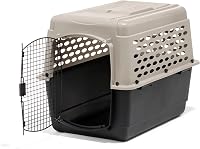
The Petmate Vari Kennel 36-inch has a plastic shell, a wire door and ventilation on 4 sides. Its interior measures 32.5 x 22.2 x 26 in, and it's designed for dogs weighing 50 to 70 lb.
Its shell wipes clean, and a stay-dry moat directs fluids away from the dog. Petmate says the kennel meets most airline cargo specifications, but airline and route rules can differ, so confirm acceptance before travel.
This kennel suits a dog whose measurements fit its interior and a buyer who wants a solid-sided design. Skip it if the dog needs more interior room, or if a hard-sided crate is difficult to store in your home.
PetSafe Happy Ride collapsible travel crate: a car-focused option
The PetSafe Happy Ride measures 27 x 19 x 28 in and is designed for pets up to 60 lb. It has mesh front and sides, 2 doors, a headrest strap, seatbelt slits, storage pockets and a cushioned pad with a removable waterproof fleece cover.
The strap and seatbelt slits make its vehicle setup a key part of the decision. The cover and outer shell are machine washable, which can help after a messy trip.
It suits a calm dog who fits the compact dimensions and a buyer seeking a collapsible car crate. Skip it for a dog who chews or pushes against fabric, or when you need a roomier kennel.
How do these dog crates differ?
The MidWest and Amazon Basics models are wire crates with dividers and removable trays. The Petmate is a hard-sided kennel, while the PetSafe is a soft collapsible crate with car-specific restraint features.
| Example | Type | Main fit |
|---|---|---|
| MidWest iCrate | Wire | Large dog, divider and single-door access |
| Amazon Basics 42-inch | Wire | Two-sided access and adjustable interior |
| Petmate Vari Kennel 36-inch | Plastic | Hard-sided enclosure with 4-sided ventilation |
| PetSafe Happy Ride | Soft travel crate | Compact car setup with strap and seatbelt slits |
Use the table to decide which design deserves a closer look. Then compare the crate's interior with your dog's measurements and check that you can set it up properly where it will be used.
Where should you put a dog crate?
Put the crate in a calm, accessible spot where your dog can rest and you can check on them. Leave enough clearance to open the door fully, reach inside and clean around it.
Avoid blocking ventilation or placing the crate where a busy walkway makes access awkward. Keep it away from places where doors, heaters or furniture interfere with the crate or its entry.
If you plan to move it between rooms, consider the crate's handles, weight and whether it folds or comes apart. For more placement advice, see where to put a dog crate in your home.
What should you put inside a dog crate?
Start with only items your dog can use safely, and leave enough open space to move naturally. Bedding or a mat can make sense if your dog won't chew or pull it apart.
A fitted tray or travel pad may already meet your needs. Avoid items that block ventilation, interfere with the door or create a hazard for your dog.
Our guide to what to put in a dog crate covers bedding, toys and other choices. For a puppy, supervise how they handle each item before leaving it in the crate.
How do you set up and use a dog crate?
Set up the crate on a stable, level surface and check its panels, doors, latches and tray before use. Follow the instructions for the specific design, since wire, hard-sided and soft crates have different connections and closures.
For wire models, confirm the crate is fully opened and secured, the tray sits correctly, and each door latch closes. If there's a tray hook, lock it after the tray is installed.
For a soft travel crate, check that its frame is fully expanded and the restraint features are used as directed. Put it in the intended vehicle position before the trip so you can confirm that doors remain accessible.
Introduce the crate in a calm way, with the door open at first if that suits your dog. Let your dog explore at their pace.
Avoid using the crate as punishment. For a fuller walkthrough, see how to set up a dog crate.
How do you choose a dog crate for car travel?
Choose a car crate that fits the vehicle and can be secured according to its instructions. Check its dimensions against the space available, including room for passengers and safe access.
A soft car crate and a hard-sided kennel have different setup needs. The PetSafe Happy Ride has a headrest strap and seatbelt slits, while a hard-sided kennel needs a placement and restraint plan that suits your vehicle.
Don't assume a crate is secure just because it sits on a seat or in the cargo area. Follow the crate and vehicle instructions.
Check the arrangement before driving. See how to secure a dog crate in a car for the setup questions to consider.
What mistakes should you avoid when buying dog crates?
The most common mistake is choosing by breed label or exterior size alone. Measure the dog and compare those measurements with the usable interior before deciding.
Other mistakes can make a suitable crate frustrating to use:
- Buying a crate that fits the dog but not the room, door swing or vehicle.
- Assuming every crate in a weight range has the same interior dimensions.
- Leaving a puppy with too much unused space instead of setting a divider.
- Choosing a soft crate for a dog who chews or pushes fabric.
- Assuming an airline-friendly description means a carrier will meet the rules for every airline and route.
- Forgetting to secure the tray hook or close every latch after setup.
- Treating a car crate as secure without following its restraint instructions.
Check the whole setup, not just the product category. The right choice is the crate that fits your dog, works in its intended location and can be used as directed.
Which dog crate should you choose?
Choose the MidWest iCrate for a large dog that fits its interior and a straightforward wire setup with a divider. Choose the Amazon Basics model if access from the front and side matters and its size guidance fits your dog.
Choose the Petmate Vari Kennel for a dog that fits its interior and needs a hard-sided enclosure. Choose the PetSafe Happy Ride for a calm dog who fits its compact dimensions and a car setup that works with its straps.
If none of those match your needs, settle the basic questions in this order: measure your dog, measure the space, choose wire, plastic or soft construction, then check the door, latch and cleaning method. For a final comparison, use the dog crate size guide for Labradors or wire vs plastic comparison.
Frequently asked questions
How do I choose the right dog crate?
Choose a crate that gives your dog room to stand, turn around and lie down, then match its material and door layout to how you'll use it. Measure your dog and the intended spot, check the crate's interior and exterior dimensions, and consider whether you need a divider, portability or a covered design.
Is a wire or plastic dog crate better?
A wire crate offers open sides, a removable tray and often a divider, which can suit indoor use and changing space needs. A plastic crate has solid sides and can suit travel.
Compare ventilation, cleaning, fit and your dog's comfort before choosing either type.
How much room should a dog have in a crate?
Your dog should be able to stand without crouching, turn around and lie down in a natural position. Measure your dog while standing and lying down, then compare those measurements with the crate's usable interior space rather than relying only on breed or weight.
Can I use one dog crate at home and in the car?
You may use a crate in both places if its size, construction and setup suit each job. A fold-flat wire crate can be moved, while a travel kennel or car crate may be easier to secure for a trip.
Follow the crate and vehicle instructions for safe placement.
Should I buy a crate with a divider for a puppy?
A divider lets you adjust the available space as a puppy grows, so you may avoid buying a second crate right away. Set the divider to allow standing, turning and lying down without giving your puppy a large unused area.
Recheck the fit as your dog grows.