How to Choose a Wire Dog Crate: Size, Doors, Tray
Choose a wire dog crate that lets your dog stand, turn and lie down comfortably, then check door placement, tray access and whether a divider suits your dog's age. Measure your dog and the spot where the crate will go before comparing models.
On this page (7 sections)
- How do you choose the right wire dog crate size?
- Should you choose one door or two?
- What should you look for in the tray?
- Which wire crate features matter for everyday use?
- Which wire dog crate examples fit common needs?
- How do you set up a wire dog crate safely?
- How do you choose between these wire crates?
Choose a wire dog crate that fits your dog's current size and your room layout. Measure your dog, check that the crate allows comfortable movement, then compare the door positions, divider and removable tray.
Measure both your dog and the intended spot before you choose. A crate's outside dimensions may not match the space your dog can use.
For a broader look at crate styles and sizing, start with our dog crate buying guide. This guide focuses on wire crate fit, access and cleanup.
How do you choose the right wire dog crate size?
Choose a wire dog crate by comparing your dog's standing height and body length with the usable interior dimensions. Your dog should be able to stand without crouching, turn around and lie down in a natural position.
Measure from the nose to the base of the tail for length. Measure from the floor to the top of the head or ears, whichever is higher, while your dog stands in a relaxed posture.
Use the measurements as a starting point, then check the crate's interior size. Outside dimensions include the frame and may not match the space your dog can use.
How to measure a dog for a wire crate
Measure your dog's length and height while it stands on a level surface. Use a soft tape measure and record both measurements in inches.
If your dog is between sizes, compare the interior measurements of the next size up. A little extra room can be helpful, but a very large crate may make it harder to keep a consistent sleeping area during house-training.
For a step-by-step method, read how to measure a dog for a crate. It covers the measurements to take before you compare crate dimensions.
When does a divider help?
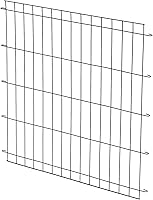
A divider lets you adjust the usable area of a larger crate. It can suit a puppy who will grow into the crate, as long as the divider leaves enough room for comfortable movement now.
Check whether the divider comes with the crate. The MidWest iCrate and Amazon Basics crate below include one, while the New World by MidWest model does not include a divider.
Should you choose one door or two?
Choose two doors when you want more placement options. A front door and a side door can make access easier if one side of the crate sits near a wall or furniture.
A single door may be enough when the crate will face an open area. Either way, check that the door can swing fully and that you can reach the latch without moving the crate.
Measure the available floor space with the doors open. If your room has a narrow walkway, the side entrance may be more useful than a larger front opening.
What should you look for in the tray?
Look for a removable tray that you can reach and clean without dismantling the crate. A tray also needs to stay in place while your dog moves around.
Check how the tray is held. The Amazon Basics model has a metal hook at the bottom to help keep its plastic tray from moving, and its instructions say to lock the hook after installing the tray.
The MidWest iCrate and New World crate include a leak-proof tray. The Precision Pet crate includes a removable, shatter-resistant pan.
Before use, confirm that the tray is seated correctly and that any retaining hook or latch is secured. Remove bedding first when cleaning, and follow the care instructions for the tray material.
Which wire crate features matter for everyday use?
The most useful features depend on where the crate will sit and how often you move or clean it. Compare the door layout, tray, divider and folding design against your routine.
| Feature | Why it matters |
|---|---|
| Front and side doors | Gives you more ways to place the crate and reach your dog |
| Removable tray | Makes it easier to clean the base |
| Divider panel | Adjusts the usable space as a puppy grows |
| Folding frame | Helps with storage or transport between uses |
| Latches | Keep doors closed during ordinary use |
| Rubber feet | Help protect the floor beneath the crate |
Wire crates have open sides, so the room around the crate remains visible. Think about whether that fits your dog's needs and your home's traffic, noise and light.
If you need to store or transport the crate between uses, see how to fold a wire dog crate. Follow the setup and folding directions for the model you choose.
Which wire dog crate examples fit common needs?
These four examples show differences in size, doors, tray and divider. Match their features to your dog's measurements and the space available.
MidWest 42-inch double door iCrate
The MidWest 42-inch double door iCrate is the highest-scoring option in this guide, at 9.2. It has front and side doors, a divider panel, a leak-proof tray, rubber feet and a carrying handle.
It measures 42.88 x 28.75 x 30.38 in and is described for dogs weighing 71–90 lb. MidWest recommends considering its 48-inch model for dogs near the top of that range.
Consider this option if the measurements suit your dog and you want the divider included. Check the outside dimensions against your floor space and route into the room.
Amazon Basics 42-inch double door wire crate
The Amazon Basics 42-inch double door wire crate scores 8.8 and includes a divider, front and side doors, and a removable plastic tray. It folds flat for transport or storage.
It measures 42 x 28 x 30 in and is intended for pets under 38 x 26 in (L x H). Compare your dog's measurements with that guidance before choosing.
Consider this option if the stated fit and dimensions work for your dog and home. Lock the tray hook after installation and check that it remains secure during use.
Precision Pet 36-inch two-door wire crate
The Precision Pet 36-inch two-door wire crate scores 8.6 and includes a removable pan and divider, with a five-point locking system. It measures 36 x 23 x 25 in and is described for pets weighing 50–70 lb.
Precision Pet advises sizing up if you are unsure. Compare the interior space with your dog's measurements.
Consider this option if your dog fits the size and you want a divider included. Precision Pet describes the finish as rust-resistant and suitable for occasional outdoor use.
New World by MidWest 42-inch double door crate
The New World by MidWest 42-inch double door crate scores 8.5. It has front and side doors, a leak-proof tray and rubber feet, while its compatible divider panel is sold separately.
It measures 42.88 x 28.75 x 30.38 in and is described for dogs weighing 71–90 lb. MidWest recommends considering its 48-inch model for dogs near 90 lb.
Consider this option if the size fits and you do not need an included divider. Add a compatible divider to your comparison if you plan to use one.
How do you set up a wire dog crate safely?
Set up the crate on a level surface, secure its tray and check the latches before your dog uses it. Follow the assembly instructions for the exact model because panels and locks can differ.
Check each door by opening and closing it several times. Confirm that the latches engage, the frame feels stable and the tray does not slide out.
Put the crate where your dog can rest without blocking a busy route through the home. Our guide to where to put a dog crate covers placement and room considerations.
How do you choose between these wire crates?
Choose the MidWest iCrate or Amazon Basics model if you want a 42-inch crate with a divider included. Consider the Precision Pet 36-inch crate for a smaller fit, or the New World model if you prefer a 42-inch crate and can source a separate divider if needed.
Before you buy, verify the dimensions, door clearance and tray setup against your dog and home. For more options, compare our best wire dog crates, then use the crate setup guide when the crate arrives.
For safe use, check the crate regularly for loose latches, damaged wires or a tray that no longer stays in place.
Frequently asked questions
How do I choose the right size wire dog crate?
Measure your dog's length from nose to tail base and height while standing, then compare those measurements with the crate's usable interior. Your dog should be able to stand, turn around and lie down naturally.
If your dog is still growing, a divider can make a larger crate easier to size for now.
Is a single-door or double-door wire crate better?
Choose a single-door crate if its entrance faces an open area and works with your room layout. A double-door crate adds a side entrance, which can help when the front is blocked by a wall or furniture.
Check the door swing and latch access before placing the crate.
Are wire dog crates easy to clean?
A wire crate with a removable tray is usually simpler to clean than one with a fixed base. Check whether the tray slides out easily and whether a hook or latch keeps it from moving during daily use.
Remove bedding and follow the crate maker's care instructions.
Should I buy a wire crate with a divider?
A divider can reduce the usable space in a larger crate while a puppy grows, so you may not need to replace the crate as soon. Check whether the divider is included, since some models sell it separately.
Set it to leave enough room for your dog to stand, turn and lie down.
What should I check before using a wire crate?
Check that every latch closes, the tray is seated and secured, and the crate is stable on the floor. Look for gaps, sharp edges or damaged wires before each use.
Follow the crate maker's assembly instructions and give your dog time to get used to the space.