How to Choose a Dog Crate: Type, Size and Doors
To choose a dog crate, match its type, interior size and door access to your dog and where you'll use it. Measure your dog and the space first, then compare home and travel options.
On this page (8 sections)
Choose a dog crate by matching its type, size and doors to your dog and the place you'll use it. Measure your dog and the available space before comparing wire crates, hard-sided plastic kennels and travel crates.
A crate should fit your dog and work with your daily routine. Start with measurements, then think through where the crate will sit, how your dog will enter, and how you'll clean or move it.
For a broad overview of crate styles and uses, see our dog crates buyer's guide. If wire is already your likely choice, our wire dog crate guide covers doors, trays and other details.
How do you choose a dog crate type?
Choose a crate type based on where you'll use it and which features help there. Wire crates often suit home use, hard-sided plastic kennels can suit travel, and collapsible travel crates can fit some vehicle setups.
| Type | Consider it for | Check before choosing |
|---|---|---|
| Wire | Home use, a divider, removable tray or an open view | Door position, footprint and how the crate folds |
| Hard-sided plastic | A kennel with a shell, wire door and ventilation | Interior fit, door security and travel requirements |
| Collapsible travel | Vehicle trips where a foldable crate and attachment features matter | Weight limit, access and how it attaches |
These broad differences help narrow the options, but each crate still needs to fit your dog and setting. Check its specific interior measurements and features before deciding.
Is a wire crate right for your dog?
A wire crate can suit home use if you want an open-sided enclosure with a divider or removable tray. Consider the room layout too, because the door needs room to open.
The MidWest 36-inch single-door iCrate has a divider panel, leak-proof tray, rubber feet and carry handle. MidWest describes it for dogs weighing 41–70 lb and suggests its 42-inch model for dogs near 70 lb.
This is a sensible home option if its interior fits your dog and a single entrance works in the spot you have chosen. Skip it if you need a hard-sided travel shell or access from more than one side.
A divider can help you adjust the usable area as a puppy grows. Set it for your dog's current size, then move it as needed instead of leaving a young dog with excess space.
Wire crates also fold flat for storage, though you'll need room to unfold them and a clear place for the door. For more help comparing wire features, read our wire dog crate guide.
When does a plastic crate make sense?
A hard-sided plastic crate can suit travel if you want a shell, a wire door and ventilation on several sides. Check the rules for your specific trip before counting on any kennel for air travel.
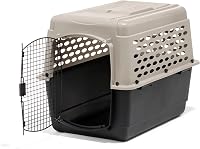
The Petmate Vari Kennel 36-inch has a plastic shell, four-sided ventilation, an easy-open wire door and tamper-proof holes for zip ties. Its interior measures 32.5 x 22.2 x 26 in, and Petmate describes it for dogs weighing 50–70 lb.
Choose it if your dog fits inside and you want a portable kennel with a shell. Skip it if the usable interior is too small, or if you need a foldable crate that stores compactly between trips.
For air travel, contact the airline about its current crate requirements and your specific route. Petmate describes the kennel as meeting most airline cargo specifications, but airline acceptance depends on the carrier.
For car use, check that the kennel fits the vehicle area and that its door remains reachable. See our guide to securing a dog crate in a car for setup considerations.
Is a collapsible travel crate the right choice?
A collapsible travel crate can suit car trips when the crate fits the seat, your dog and the attachment setup. Check its weight limit and how it secures before you use it in a vehicle.
The PetSafe Happy Ride measures 27 x 19 x 28 in and is designed for pets up to 60 lb. It has two doors, mesh front and sides, a headrest strap, seatbelt slits and a cushioned pad with a removable waterproof fleece cover.
Pick it if you want a crate that folds for storage and its attachment points suit your car. Skip it if your dog exceeds the stated weight limit, needs more interior room, or the seat setup can't accommodate the crate securely.
The two doors can make entry easier from either side, while the pockets can hold travel items such as treats and a leash. Wash the removable outer shell and fleece cover according to their care instructions.
Read our dog crate versus carrier comparison if you're deciding between travel options.
How do you choose the right crate size?
Choose a crate with enough interior room for your dog to stand, turn and lie down comfortably. Use your dog's measurements and the crate's interior dimensions instead of relying on a size label or weight range alone.
Measure from the nose to the base of the tail, then from the floor to the top of the head. Compare both measurements with the space inside the crate, paying particular attention to interior height.
Our guide to measuring a dog for a crate explains how to take those measurements. If you're shopping for a Labrador, see our Labrador crate size guide.
Should you size by weight or measurements?
Use measurements as your main check because dogs at the same weight can have different heights and body lengths. A weight range can narrow your choices, but it won't confirm that the interior shape fits.
The Homey Pet 37-inch crate has an interior measuring 35.5 x 21.5 x 22.5 in. Homey Pet describes it for dogs weighing 25–60 lb and gives fit guidance for dogs up to 34 in long and 22 in tall.
Choose it if your dog fits the interior and the open top, side door, wheels or stackable design suit your home. Skip it if your dog needs more interior space or you don't need its heavier, movable setup.
Check the full usable dimensions, not just the crate's advertised size. A dog within a stated weight range may still be too tall or long for the interior.
Should you leave room for a growing puppy?
A crate with a divider can let you adjust its usable space as your puppy grows. Set the divider for your puppy's current size, then reposition it as your dog gets bigger.
The MidWest iCrate includes a divider panel, which can make it a practical option if you want one crate to adapt over time. Measure your puppy and set the space to suit your current training setup.
Don't buy a much larger crate on the assumption that extra room is always better. The usable area should fit your puppy now, and you should reassess it as the dog grows.
How many doors should a crate have?
Choose the door count and position that let you reach your dog easily where the crate will sit. One entrance can work in an open area, while two doors can help when access from either side matters.
A single door is often enough when there's clear space in front of the crate. A second entrance can be useful in a vehicle or a tight room where one side may be blocked.
The MidWest iCrate has one door, the Petmate Vari Kennel has a wire door, and the PetSafe Happy Ride has two doors. The Homey Pet crate adds a side door and open top.
Mark the crate's footprint and check that its doors can open without hitting furniture, a wall or a seat. Also check whether you can reach inside to help your dog or remove a tray.
Which features matter for daily use?
Choose features that support your space, routine and cleaning needs. A divider, removable tray, folding frame, wheels or extra access can help when it solves a real problem in your home.
- Divider: adjusts the usable space as a puppy grows.
- Removable tray: provides a removable surface for cleanup.
- Folding frame: helps when you need to store or move the crate between uses.
- Lockable wheels: can make it easier to reposition a crate between rooms.
- Multiple doors or an open top: provide access when the crate's position limits one entrance.
The Homey Pet crate has an open top, side door, removable tray, two metal floor grids and four lockable wheels. Its stackable design may suit homes with multiple pets, but make sure the interior fits before choosing it for that reason.
The Homey Pet crate is a poor match if you need a lightweight option to carry frequently. Its listed product dimensions include a 42 lb weight, so plan where it will sit before assembling it.
The PetSafe Happy Ride folds for storage and has two pockets for small travel items. Its intended vehicle setup and fit should guide your choice, not the pockets alone.
How should you set up and care for a dog crate?
Set up a crate on a stable, suitable surface and make sure its doors and access points work in the chosen spot. Follow the crate's assembly and care guidance, and check its parts regularly for damage.
Before assembly, measure the area where you plan to place the crate, including the clearance needed for its door. For a wire model, make sure it is fully unfolded and secured according to its instructions before your dog uses it.
Check that latches close properly and that trays, grids, straps or wheels are positioned as intended. For the Homey Pet crate, remove the bowl holder when no bowl is installed to reduce entanglement risk, and don't use damaged or deformed floor grids.
Keep the crate clean by removing waste and debris regularly. The Petmate shell can be wiped down, while the PetSafe outer shell and fleece cover are machine washable; check the manufacturer's care directions for the model you choose.
For a room-by-room placement guide, read where to put a dog crate in your home. Our dog crate cleaning guide covers routine cleanup.
What mistakes should you avoid when choosing a dog crate?
Avoid choosing by weight or advertised size alone. A crate can fit a weight range and still be too short, low or awkwardly shaped for your dog.
Measure the dog and compare those measurements with the interior dimensions. Don't confuse outside dimensions with usable room inside, and leave enough space around the crate for its doors and regular access.
Another common mistake is choosing features before confirming fit. Wheels, a divider or a second door only help if the crate is the right size and works in the place you plan to use it.
Don't assume that a travel description guarantees acceptance by an airline or a secure fit in your car. Check the airline's rules or the vehicle attachment method for the exact trip and setup.
For puppies, avoid leaving a divider at a position that gives too much room for your current training arrangement. Recheck the fit as your dog grows, and adjust the divider when needed.
Which dog crate should you choose?
To choose a dog crate, start with your dog's measurements, then match the crate type and access to its main use. The right choice is the one that fits your dog and works in your home or vehicle.
Choose the MidWest iCrate for a wire home crate with a divider and tray. Choose the Petmate Vari Kennel if you need a hard-sided kennel and its interior fits your dog and travel plan.
Choose the PetSafe Happy Ride for a collapsible vehicle crate if its dimensions and attachment method suit your seat. Choose the Homey Pet crate if its interior fits and you want stackable storage, a side door, an open top or wheels.
Measure your dog and the space before you buy. For a wider overview of crate types, continue to our dog crates buyer's guide.
Sources
- U.S. Department of Transportation: Traveling with Animals
- American Veterinary Medical Association: Traveling with Your Pet FAQ
Frequently asked questions
How do I choose the right size dog crate?
Measure your dog from nose to tail base and from the floor to the top of the head, then compare those measurements with the crate's interior dimensions. Your dog should have room to stand, turn around and lie down.
Check the maker's size guidance, since weight alone won't show whether the interior shape fits.
Is a wire or plastic crate better?
A wire crate can suit home use when you want an open view, a removable tray or a divider. A hard-sided plastic crate can suit travel when you want a shell with a door and ventilation on several sides.
Choose based on the setting, your dog's fit and the crate's intended use.
How many doors should a dog crate have?
One door can work when the crate has a clear approach and stays in one spot. Two doors can make entry easier from different sides, especially in a vehicle or a tight room.
Measure the space around the crate and check which door positions you'll be able to reach.
Can I buy a crate my puppy will grow into?
You can choose a crate with a divider if it lets you adjust the space as your puppy grows. Set the usable area to fit your puppy now, then move the divider as needed.
A crate that's too large for your current training setup may leave room for your puppy to use one end as a toilet.
Can I use a soft travel crate as my dog's main crate?
A soft travel crate can suit supervised trips if your dog is comfortable in it and the crate fits the vehicle setup. Check its stated weight limit, doors and attachment method.
For daily home use, compare the material and features with your needs, and follow the maker's care and safety guidance.